
Teaching Calm: How Tie Back Training Helps Puppies Settle at Home


⭐ Teaching Calm With My Girl Aurora
Bringing a new puppy home is exciting, but it can also feel chaotic. Puppies explore nonstop. They chew, wander, chase the kids, and follow you room to room like tiny shadows with legs. As many of you know, I am keeping my girl Aurora, and I am starting her house manners early with one of my favorite training tools. It is simple, safe, gentle, and life changing for both families and puppies. This approach includes tips on how to teach a puppy to settle.
It is called a tie back which is also known as a stationary tether.
A tie back is not a punishment and it is not used to correct a puppy. It is simply a short, secure lead attached to a sturdy point in your home. It gives your puppy a clear boundary while still letting them see you, hear you, and be part of your daily routine.
This is what a tie back looks like inside my home. These are real moments, from Aurora’s point of view, in real everyday family life.
When we all get up from the couch to grab snacks in the kitchen
Aurora stays calmly in her spot. She is not sneaking down the hallway or looking for trouble. She is learning that she does not need to follow every single footstep to feel secure.
When the boys run across the room with toys
Aurora watches quietly. She settles. She does not chase or jump or spiral into puppy zoomies. This teaches her to handle movement and excitement without reacting to it.
When someone knocks on the front door
She cannot bolt or slip outside. She sits and observes because the tie back gives her a clear and safe boundary.
When I am cooking dinner
She is not under my feet or licking the floor or checking the dishwasher. She can see me and hear me, but she stays calm rather than trying to be involved in every moment.
When I move from room to room
Aurora stays settled. She learns that people can move and she does not have to. This is one of the most important lessons in raising a well mannered adult.
When curiosity kicks in
Instead of wandering into another room to chew something or potty where she should not, the tie back keeps her anchored and safe. Structure is everything with young puppies.
When she gets tired
She naturally lays down and rests. This helps her learn self regulation which is the foundation of confidence and emotional stability.
Here is the part that truly shapes her behavior.
When Aurora stays seated as I walk by, I stop and pet her. Calm behavior earns calm attention.
When she pops up, stretches toward me, or tries to jump, I do not respond. I do not look at her or talk to her because that teaches her that excited behavior gets results. I simply keep moving. She learns that calm behavior makes good things happen and excited behavior does not.
This is how you build a puppy who stays grounded.
A puppy who observes instead of reacts.
A puppy who understands boundaries without fear or pressure.
Now let us talk about barking, because every puppy will test this at some point.
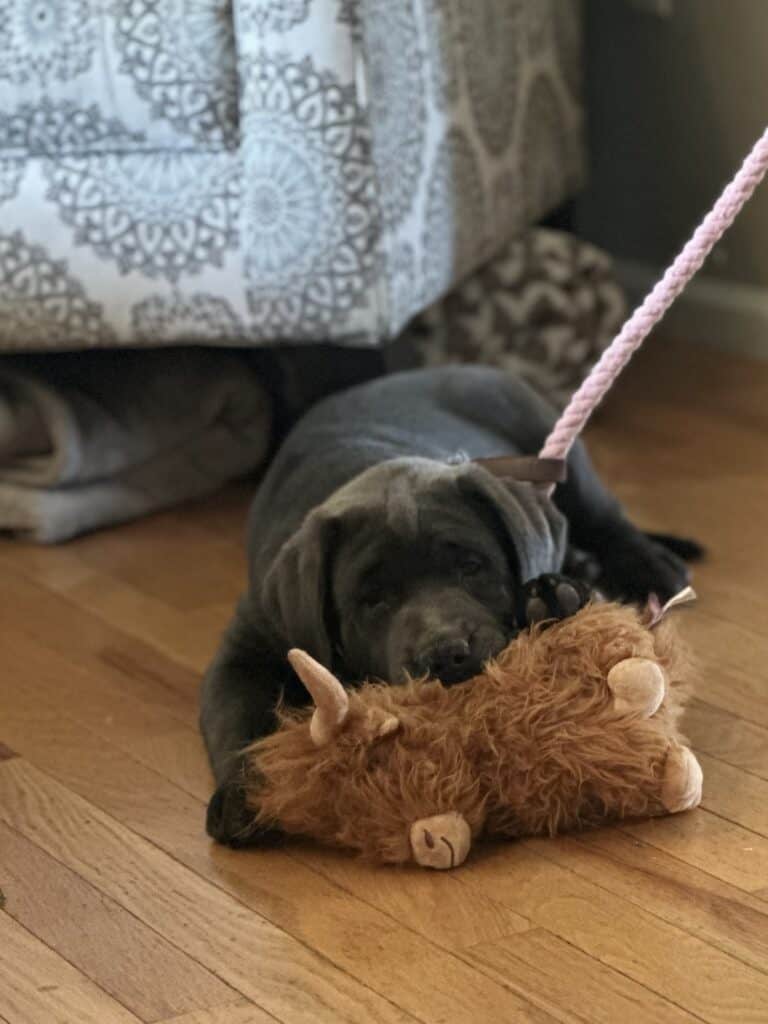
⭐ What To Do When Your Puppy Barks On The Tie Back
Persistent barking is not attitude. It is communication.
A puppy barks for reasons like being overstimulated, overtired, confused, or wanting attention. You cannot train through needs, only through behavior. So before you jump into training, always check the basics.
Is she tired
Overtired puppies cannot regulate and will bark through frustration.
Did she potty recently
If not, she may genuinely need to go.
Is the environment chaotic
Too much movement or excitement raises arousal and causes barking.
Did she have any mental stimulation
Puppies need brain work, not only physical work.
If any of those needs are not met, fix the need first.
If her needs are met and she still barks, here is the correct training approach.
⭐ Step One: Do nothing for the barking
No noise.
No chh.
No eye contact.
No walking toward her.
No correcting.
No talking.
Any attention teaches her that barking works.
⭐ Step Two: Reward the quiet moments
Do not wait for long silence.
Reward the micro pauses.
Reward one inhale.
Reward one second of stillness.
Quiet brings connection.
Barking brings nothing.
This is exactly how you teach emotional control at a young age.
⭐ Step Three: Give her a job if she needs one
Some puppies cannot handle “do nothing.” Their brain is too young. Give her something productive:
A bully stick
A chew
A crinkle toy
A stuffed Kong
A lick mat
This is strategic redirection.
Think of it like giving a toddler crayons instead of asking them to sit silently in a chair with nothing to do.
⭐ Step Four: Keep sessions short
If barking goes on and on even with proper handling, it means she is mentally over her threshold. End the session and reset.
Tie back training should begin with two to three minutes and slowly increase.
⭐ Step Five: Never release her while barking
If you unclip her when she is barking, she learns:
Barking equals freedom.
That will follow her for life.
Always wait for silence or stillness before releasing.
This is the real formula that always works.
If she is barking, I do nothing.
If she stops, I reward it.
If she needs a job, I give her one.
If she is overstimulated or tired, I shorten the session.
If she is calm, I praise her quietly.
If she tries again, I stay consistent.
This is how a puppy learns to observe instead of react.
This is how a puppy becomes calm, patient, and emotionally stable.
Tie back training is kind. It is simple. And it sets puppies up for a lifetime of good manners, emotional balance, and trust.
Aurora is already thriving with this routine. She knows that calm gets connection and chaos gets nothing. And that one lesson will carry her through her entire life.
If you have a new puppy at home, consider adding a few minutes of tie back training each day. Your puppy learns how to settle and you gain peace, predictability, and a calm companion for years to come.




 Weeks 1–3


Responses